
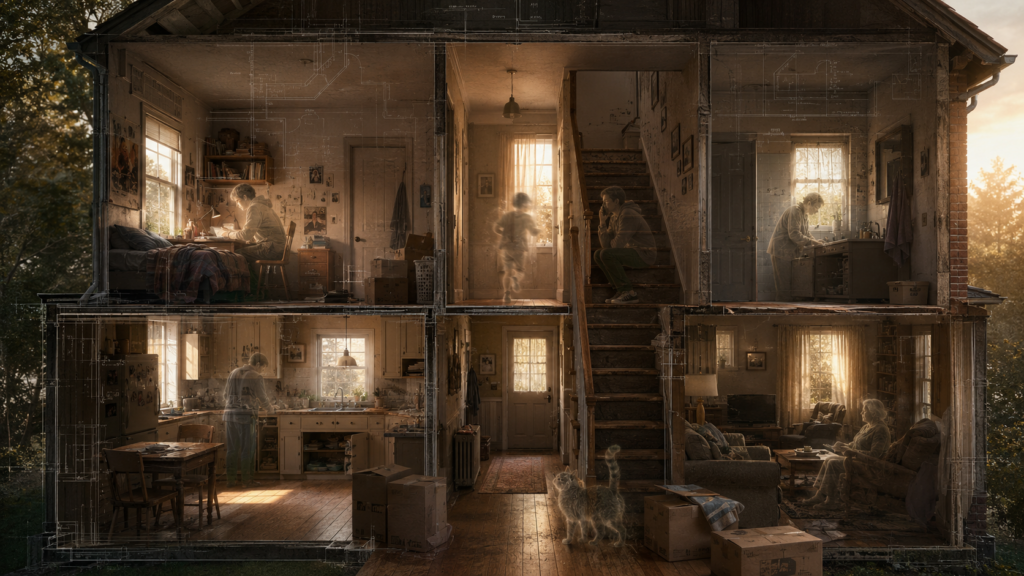
There are places I know so well that I could walk through them with my eyes closed.
Not famous buildings. Not beautiful buildings. Just ordinary places.
A hallway. A bedroom. A staircase. A kitchen.
I know where the floor changes under my feet. I know which door needs a harder push. I know where the light falls in the afternoon. I know the exact step where someone usually sits when they are talking on the phone. I know exactly which floorboard will creak before I even step on it –thanks to years of sneaking around as a kid, trying not to make a sound as a kid while pranking my sister.
None of these things are important enough to be on a floor plan.
But somehow they are the things I remember most. Even when I leave for college, even if we rent the house out and strangers begin building their own little world inside the same rooms, they won’t know what happened where. They won’t know whose favorite corner was whose, which doorway someone leaned against, the corner my cat always scratches her head, the place where my dad always works, the desk I spend spend sleepless nights on, or why one particular stair mattered more than the others. Eventually, they’ll discover the same creaking floorboard. Maybe they’ll get annoyed by it. Maybe they will fix it. And just like that, something that once felt permanently tied to my childhood will disappear without them ever knowing it was a memory in the first place.
That is what I find strange about architecture.
We spend so much time talking about what buildings are made of, how they are designed, how they look, how they stand. But when people remember a place, they almost never remember it that way.
They remember what happened there.
They remember being eight years old and running down a hallway.
They remember sitting at the same kitchen table every morning before school.
They remember a bedroom they hated at thirteen and would do anything to see again at twenty-five.
They remember the sound of someone coming home.
And then, one day, they leave.
The building does not.
That part gets me.
You can grow up in a room, change completely inside it, cry in it, laugh in it, be sick in it, study in it, spend sleepless nights in it, lie awake in it, become a different person in it.
And when you are gone, the room is still there.
The walls do not look different because you left.
The window does not stop letting in light.
The door does not remember the last time you closed it.
Someone else can move in.
They can put their bed where yours was. They can paint over the wall you stared at, drew at, and leaned at for years. They can complain about the same corner you used to love. They can paint the wall my cat alwaysd her head on—and therefore left a gray mark on the corner.
And eventually, the space becomes theirs.
I think there is something almost painful about that.
Because we like to believe that the places that shaped us somehow belong to us.
But they don’t.
Not really.
We borrow them.
For a few years, a building lets us live inside it, and while we are there, we fill it with ourselves.
We leave shoes by the door, we make dents in sofas, we hang things badly on walls, we move furniture around, we learn exactly how far we can open a window before it gets stuck. I bet you didn’t know that, in our house, you have to hold the cabinet door under the sink with your foot while taking the throwing trash because the top hinge screw has came loose. I do. I bet you also wouldn’t know that my door only closes properly if you lift the handle slightly while pulling it -otherwise my cat breaks into my room and I am allergic to it- a movement so automatic to me now that I don’t even realize I’m doing it. Someone new would probably they are destined to sleep with their pet. I’d think they just haven’t learned the house yet.
We make a place ours through hundreds of tiny actions that no architect could ever predict.
Then we leave those things behind.
Sometimes I wonder if this is the part of architecture that drawings fail to show.
A floor plan can show me where the kitchen is.
It cannot show me who always stands by the sink.
A section can show me the height of a ceiling.
It cannot show me what it feels like to lie underneath it when you cannot sleep.
An elevation can show me a window.
It cannot show me the person who spent years looking through it, thinking about their life decisions.
Maybe that is why some completely ordinary buildings mean more to people than masterpieces.
A building does not need to be important to architecture to be important to someone. Even though my house -which I lived in for 12 years- is not one of Zaha Hadid’s masterpieces, it has more value in my heart. Because this is where I shaped my identity, had my downfalls, celebrated, loved, cried, and cheered everyone up on hard days. Even the though of selling the house -when we move out for college- makes me emotional.
Even though I love the design of my house, it is not the main reason I am so attached to it. There are ugly apartments people miss. Schools people complain about for years and then cry when they graduate. Houses with terrible tiles, awkward doors, bad lighting, tiny kitchens, cracked paint. And somehow they still become home.
Because home is not really the walls. It is repetition. It is knowing where everything is in the dark. It is hearing a sound from another room and knowing exactly who made it. It is sitting in the same place so many times that your body goes there without thinking. It is being bored somewhere long enough for that boredom to eventually become nostalgia.
I used to think good architecture was architecture that people noticed.
Now I am not sure.
Maybe the best spaces are sometimes the ones that disappear into your life so completely that you stop seeing them.
Until you have to leave.
Then suddenly you notice everything.
The doorway, the light, the view.
The stupid cabinet that always needs an extra push to shut properly (that I end up slamming out of pure rage).
The corner where my grandmother sits now, the same corner where she remembers her own mother sitting to watch TV.
You notice that these small details are what makes the space so valuable and memorable.
You notice because you know you are seeing it for the last time.
And that is when a room becomes more than a room.
It becomes something you are about to lose.
There is a moment before leaving a place for good when everything looks strangely normal.
IT’s the strange feeling of seeing your living room for the last time after everything has been taken out —the sofa gone the bookshelves empty, the decorations packed into boxes. The room looks bigger, almost unfamiliar. And yet for a second, you can still see everything exactly where it used to be. The couch is there in your head. The books are back on the shelves. Someone is sitting in their usual space. The room is empty, but somehow your memory keeps furnishing it.
That might be the worst part.
Nothing announces itself.
There is no dramatic ending.
You do not hear music.
The walls do not know this is goodbye.
You just stand there and look around.
And somewhere in your head, you are trying to memorize it.
The distance between the bed and the door.
The shape of the light.
The way the room feels when no one is talking.
You are trying to take something with you that cannot really be taken.
Later, you may forget parts of it.
The exact color of a wall.
What was on a shelf.
How wide the hallway really was.
But you remember how it felt to be there.
And that feeling can stay for years.
I personally always think I remember my old house at Russia so clearly. But in reality, I only remember the experiences. I know how it felt like to like in that house. I do not know a single wall color or furniture.
That is what makes architecture feel almost unfair to me.
Buildings can outlast us, but our version of them cannot.
The building stays.
The life inside it changes.
A new family arrives.
A classroom gets new students.
A café replaces its furniture.
A bedroom becomes an office.
Eventually, the place that exists in your memory and the place that exists in real life become two different places. I do not know what happened to that house, but I also do not want to know it. Because I know if I do, I will feel like all my memories got destroyed.
And maybe that is why returning somewhere from your childhood can feel so disappointing.
You expect the building to contain the person you were there.
It doesn’t.
You walk in and realize the room was never holding your childhood.
You were.
I think about that a lot when I think about what kind of architect I want to become.
I do not only want to design buildings that look impressive when they are finished.
I want to design places people can actually live into. I do not want to create spaces that look like they’ve overdosed on some immortality shots—untouched, unaged, and terrified of showing any evidence that someone has actually lived there.
Places that get better when they become imperfect.
Places where a child can have a favorite stair. Where someone can sit by a window every morning for fifteen years before leaving for school. Where a wall can collect scratches and photographs and bad paint and still be beautiful because it has been used. Where the parents are not afraid to draw small lines on the wall to document their kid’s height. Where everyone in the house has their own favorite place to be in, can personalize, and make them their own. Somewhere that looks lived in thought out, comfortable, and feels like real ‘home’. Not a polished penthouse that looks like any other rich person’s house, not another modern white house -that looks like it has been constructed 2 days ago, and no one has ever entered it before- with sleek black furniture.
I want to make spaces that leave room for people to change them.
Because maybe architecture is not finished when construction ends.
Maybe that is when it finally begins.
The drawings stop.
The building opens.
People come in.
And slowly, without asking permission, they give the place a life the architect could never have drawn.
One day they leave.
But something happened there.
And maybe that is enough.
Maybe the point of architecture is not to make something that lasts forever.
Maybe it is to make somewhere worth missing.
-A Highschool Student
