
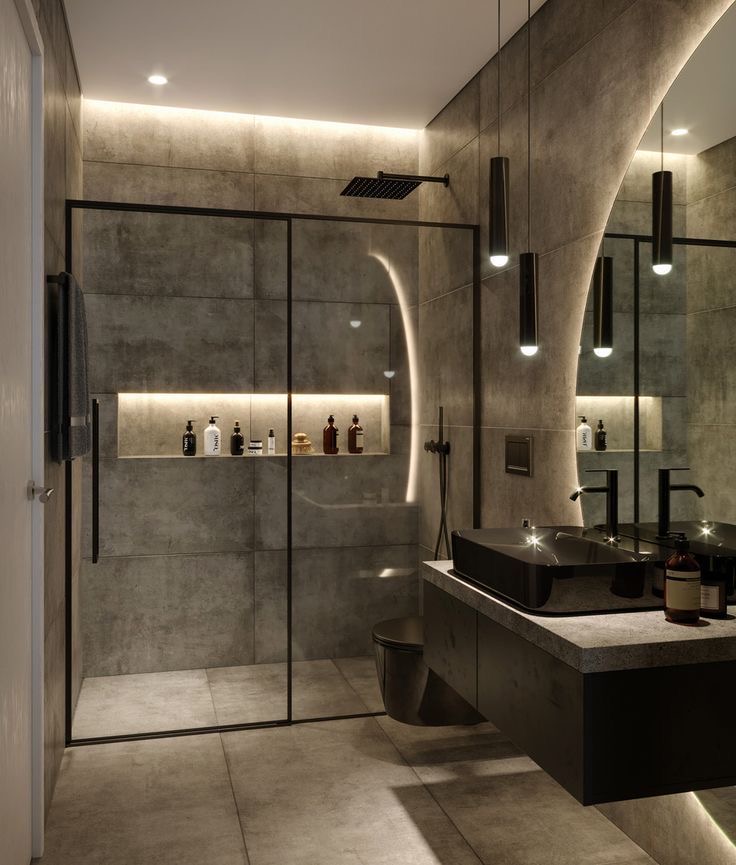
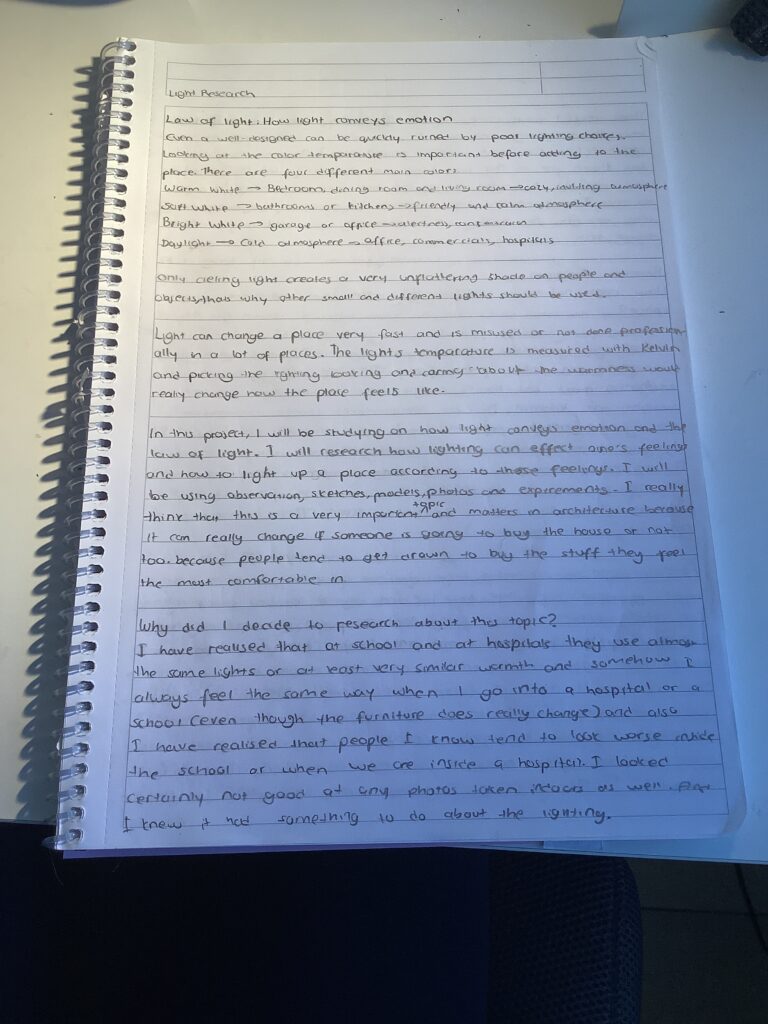
While I was about to study for physics, I found my research project I did on my own and I wanted to share it it here. I did this research based off on lighting and how it effects interior spaces. I will also upload some photos of my research on paper for reference. (I did this research in my own will, and it was in 8th grade)
Light Research
Law of Light: How light conveys emotion
Even a well-designed space can be quickly ruined by poor lighting choices. Looking at the color temperature is important before deciding on the lighting of a place. There are four different main colors:
- Warm white → Bedroom, dining room, and living room → cozy, inviting atmosphere
- Soft white → Bathrooms or kitchens → friendly and calm atmosphere
- Bright white → Garage or office → alertness, concentration
- Daylight → Cold atmosphere → offices, commercial spaces, hospitals
Only ceiling light creates a very unflattering shade on people and objects, that’s why other small and different lights should be used.
Light can change a place very fast and is misused or not done professionally in a lot of places. The light’s temperature is measured with Kelvin, and picking the right lighting color can really change how the place feels like.
In this project, I will be studying how light conveys emotion and the law of light. I will research how lighting can affect one’s feelings and how to light up a place according to those feelings. I will be using observation, sketches, models, photos, and experiments. I really think that this is a very important and modern topic in architecture because it can really change if someone is going to buy the house or not too, because people tend to get drawn to buy the stuff they feel the most comfortable in.
Why did I decide to research about this topic?
I have realised that at school and at hospitals they use almost the same lights or at least very similar warmth, and somehow I always feel the same way when I go into a hospital or a school (even though the furniture does really change). I have realised that people I know tend to look worse inside the school or when we are inside a hospital. I looked certainly not good at any photos taken indoors as well. And I knew it had something to do about the lighting.
That’s why I have come to the conclusion that I wanted to learn about lighting and how I can make it better yet still effective (like not keeping people dark). Another thing that has drawn me to this topic was that I was going to get a new room and I wanted it to be the coziest possible. In my old room, I have realised that whatever furniture I bought was never enough for the cozy I was looking for, and I wanted to change that.
Research Question
How does natural vs artificial light affect the atmosphere of a space?
Natural Light
Natural light generally creates a more open, airy, and uplifting atmosphere and makes spaces feel larger and more inviting. It enhances mood and boosts energy levels due to exposure to sunlight and Vitamin D. Color temperatures change throughout the day and create different moods for all times. It produces dynamic shadows and highlights, creating depth and natural contrast. It also reveals the true colors of things more accurately due to high color rendering. It reduces eye strain when compared to harsh artificial lighting. It also creates aesthetic visual effects such as sunbeams, reflections, and natural gradients.
Artificial Light
Artificial light, on the other hand, controls the atmosphere and the mood regardless of what time of the day it is and is controllable. It can create different moods for different purposes depending on the warmth, brightness, color, and placement. It can also make places look bigger, smaller, enclosed, controlled, staged, energetic, moving, and a lot more. It comes in fixed color temperatures like warm yellow, cool white, and neutral. It can flatter or enhance depth depending on preference. Cool artificial light increases alertness and focus, while warm artificial light creates a cozy, calm atmosphere. Meanwhile, harsh fluorescent lighting can cause stress, headaches, and fatigue.
How does the time of the day change the way we experience the same room?
6:00 – 8:00 AM | Early Morning Light
Warm, soft, low-angle sunlight. Long shadows, gentle contrast. Calm, peaceful, quiet, cozy. Feels like a “fresh start” and the place feels softer and more emotional. The reason why this happens is because the sun is low and the color temperature is warmer. It is good for slow mornings, relaxation, and meditation.
10:00 – 12:00 PM | Late Morning Light
Bright and clearer sunlight, more neutral white tones and reduced shadow length. It feels energizing, productive, refreshing, and the space feels larger and awake. This happens because the sun rises higher, which means cooler color temperature. It’s best for studying, productivity, and photos.
12:00 – 2:00 PM | Midday Light
Harshest and brightest light, short shadows, and cooler color tones. Space can feel washed out or overwhelming. Maximum brightness (5500–6500 K). Great for working, detailed tasks, or very bright spaces.
3:00 – 5:00 PM | Afternoon Light
At this time of the day, the lighting softens again yet is still very bright. Warmer tones seem to appear slowly and shadows begin lengthening. The atmosphere is balanced and natural and feels welcoming and lively. Best for reading, relaxing, and socializing.
5:00 – 7:00 PM | Golden Hour
It’s most people’s favorite due to the romantic, emotional, and cozy feeling. Space feels cinematic and aesthetically very pleasing. Has dramatic long shadows, very warm and golden tones (2000–3000 K). Best for dinner settings, rewarding moments, and aesthetic photos.
7:00 – 9:00 PM | Blue Hour / Early Night
Minimal natural light and a blue-tinted ambient sky light. At this point artificial lights are starting to take over at many houses. Creates a dreamy, calm, and mysterious vibe. Space seems more quiet and intimate. Great for night routines, relaxing, and ambience lighting.
9:00 – 2:00 AM | Late Night
Overhead lights, lamps, and LEDs are used to lighten the space. Color and brightness depend on bulb type and the vibe created by the owner of the place. Good for social nights, gaming, sleepovers, and reading before bed.
2:00 – 6:00 AM | Deep Night / Darkness
Very minimal light is used and the air feels cold, faint, and diffused. The atmosphere is sleepy, isolated, and mysterious. Space may feel smaller or eerie. Best for sleep and rest.
And of course, I have my resources citations for my research down below. (I also watched a lot of Youtube videos but I do not think I can find them now)
MLA Citations
Journal Articles & Academic Research
- Mostafavi, Armin, et al. “Effects of Illuminance and Correlated Color Temperature on Emotional Responses and Lighting Adjustment Behaviors.” ResearchGate, Feb. 2024, www.researchgate.net/publication/378364335_Effects_of_illuminance_and_correlated_color_temperature_on_emotional_responses_and_lighting_adjustment_behaviors.
- “Effects of Illuminance and Correlated Color Temperature of Indoor Light on Emotion Perception.” PMC Article, U.S. National Library of Medicine, PubMed Central, www.ncbi.nlm.nih.gov/pmc/articles/PMC8275593/.
- Zhou, B., et al. “Research on the Impact of Lighting Illuminance and Color on Creative Performance and Mood.” MDPI, 2025, www.mdpi.com/2075-5309/15/10/1738.
- Durak, Ayşe, et al. “Impact of Lighting Arrangements and Illuminances on Different Impressions of a Room.” Building and Environment, 2007.
- “Effects of Indoor Lighting on Subjective Impressions and Mood States.” ScienceDirect, 2022, www.sciencedirect.com/science/article/abs/pii/S0360132322008216.
- Shahidi, Reza, et al. “Effect of Warm/Cool White Lights on Visual Perception and Mood.” PMC Article, 2021, www.ncbi.nlm.nih.gov/pmc/articles/PMC8481791/.
- ArchDaily. “How Lighting Affects Mood.” ArchDaily, 12 Aug. 2019, www.archdaily.com/922506/how-lighting-affects-mood.
- Boca Lighting. “The Psychology of Light: How Architectural Lighting Affects Our Mood and Behavior.” Boca.lighting, www.boca.lighting/the-psychology-of-light-how-architectural-lighting-affects-our-mood-and-behavior/.
- “Science of Ambience: Effect of Light on Mood.” InnovationLighting.net, 2 Oct. 2024, www.innovationlighting.net/science-of-ambience-effect-of-light-on-mood/.
- “Colour Temperature Psychology and How It Impacts Mood.” LightBulbs-Direct.com, www.blog.lightbulbs-direct.com/behavioural-impacts-of-colour-temperature-psychology/.

Really fun to read! You have a great voice.