
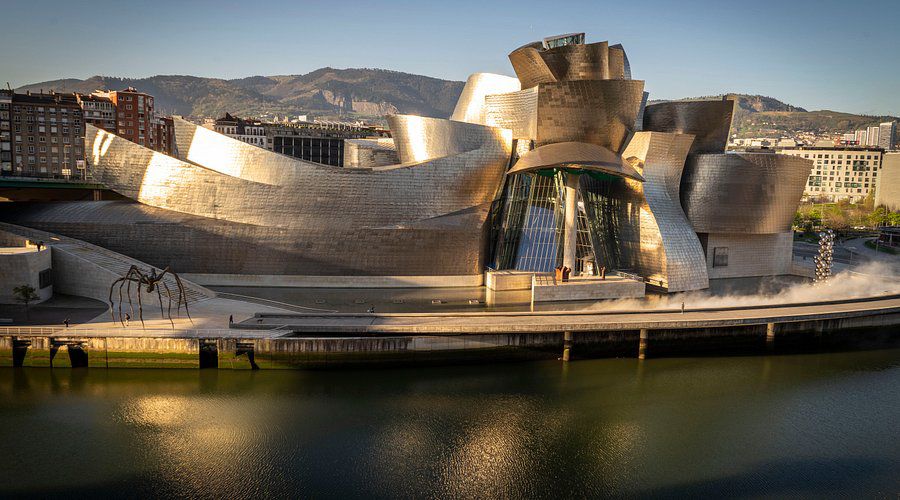
The other day, I was scrolling through an architectural feed, and among all the typical glass skyscrapers, this one builing caught my eye. It did not look like a simple building, it had flowing metal waves that made the structure calming. It was the Guggenheim Bilbao, made by Frank Gehry. The reason why Gehry design it this way is to symbolize Bilbao’s transformation from an industrial city to a vibrant cultural hub. The shiny, titanium panels reflect the river and sky, making the building feel alive and connected to its surroundings.
In my opinion, the flowy structure of the panels resemble the unstable water throughout the day and creates a magnificent view, becoming a whole with nature. I think that buildings should match the environment they are in to be able to create an aesthetic and pleasing view; and Gehry captured this so well. However, while the museum is visually stunning, I wonder about its functionality. The complex shapes might make interior spaces challenging to use efficiently. Also, if we evaluate it based on sustainability; since a huge part of it contains titanium, it makes me wonder how daylight enters the building. Although it might look very eye-catching at night, it still requires an immense amount of energy to light up the building. Considering the fact that it is made out of titanium -which is not transparent- the lightening is still going to be a problem in daylight. In my opinion, since the building color scheme is mostly gray tones, adding solar energy panels can be a great choice without changing the structure. Or another choice can be simply adding transparent material to help daylight shine through (such as glass).
Overall, Gehry’s work has taught me architecture is not only about making buildings, it is telling stories and shaping a city’s identity. It is exciting to see how daring design choices can change how people experience a place. It has also helped me find solutions for problems and improved my eye for architecture.
