
Which architectural and environmental factors encourage people to remain in cafes for extended periods?
Cafes are examples of the “third places”-spaces that are neither work nor home, yet encourage social interaction, creativity, and relaxation. In cafes, the environment suits people’s need to feel productive however also feel fulfilled and happy throughout their working experience.
Factors like comfortable seating, high ceilings, moderate background noise, color palette, lighting and even the temperature effect the way how someone focuses on a task. Thus, people tend to choose working in cafe, rather than working at home. The growing popularity of cafes for workspaces is a fascinating phenomenon. Therefore in this blog, I will break down some aspects that influence people to work in cafes in an architectural point of view.
Did you the biggest reason of how we feel in different environments is connected to our evolution? The way our brain works plays a huge role on where we choose to work for our assignments.The brain works at its best at places where it feels comfortable and safe. For most of human history, humans lived in environments where detecting danger quickly was essential for survival. Because of this, the brain continuously evaluates whether a place feels safe or threatening, often conscious awareness. Although these instincts evolved thousands of years ago, they still continue to shape how we experience modern architecture-including one of our favorite everyday spaces: cafes. This comes down to why the warm lighting in cafes affect how we focus better. In cafe’s, warm lighting (which comes down to somewhere around 2700-3000 K) resembles campfires, sunsets, safety and relaxation. Since humans evolved with warm light at night, our brains automatically associates it with safety and relaxation. Warm lighting is less stimulating than cool blue light.
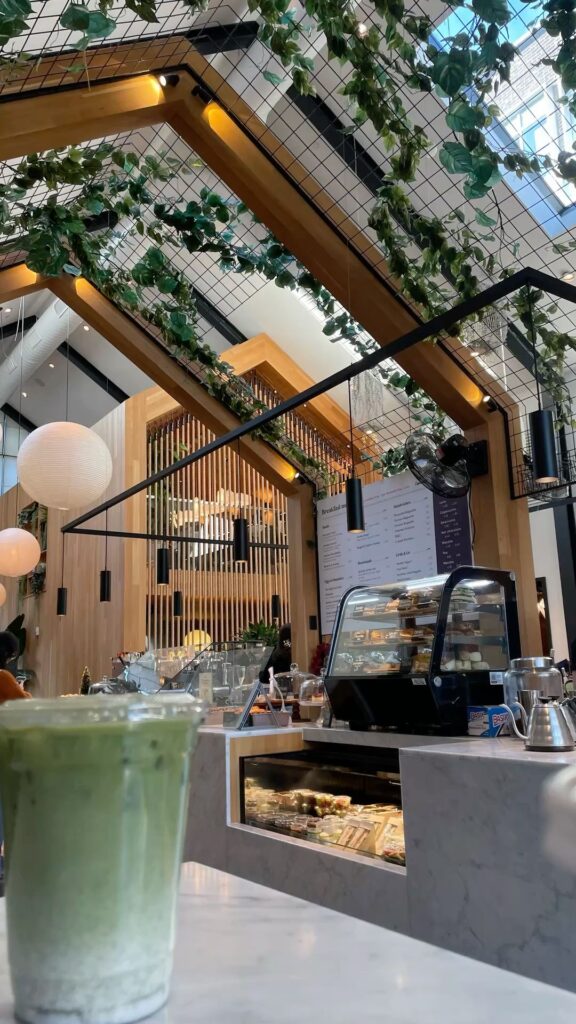
Biophilic design (an architectural and interior design approach that incorparates elements of nature into the built environment) is frequently used in order to mimic the nature and make people stay in the cafe for longer. Humans have the innate preference for nature. Cafe’s often include hanging plants, indoor trees and sometimes even large windows overlooking greenery in their interior designs. Natural elements are proven to reduce physiological and psychological stress. Even something as simple as seeing some greenery or birds through a window have positive effects.
Another thing would be the Prospect-Refuge Theory. For context, this theory is based on how people usually prefer places where they can see their surroundings, and observe (prospect) while remaining protected (refuge). This is why when you enter a cafe, the corners would most likely be full. For thousands of years, humans had to spot and watch their preys or even predators while remaining hidden and safe. As we can see, although we no longer face predators, these instincts still influence where we choose to sit. This is why people subconsciously choose seats that satisfy these instincts. The preferred seats could be listed like: window seats, corner tables, booths, o seats with a wall behind them. When we sit in these seats, both our binocular and monocular vision is engaged with the entire surroundings, making us feel protected while we keep everything within our field of view.
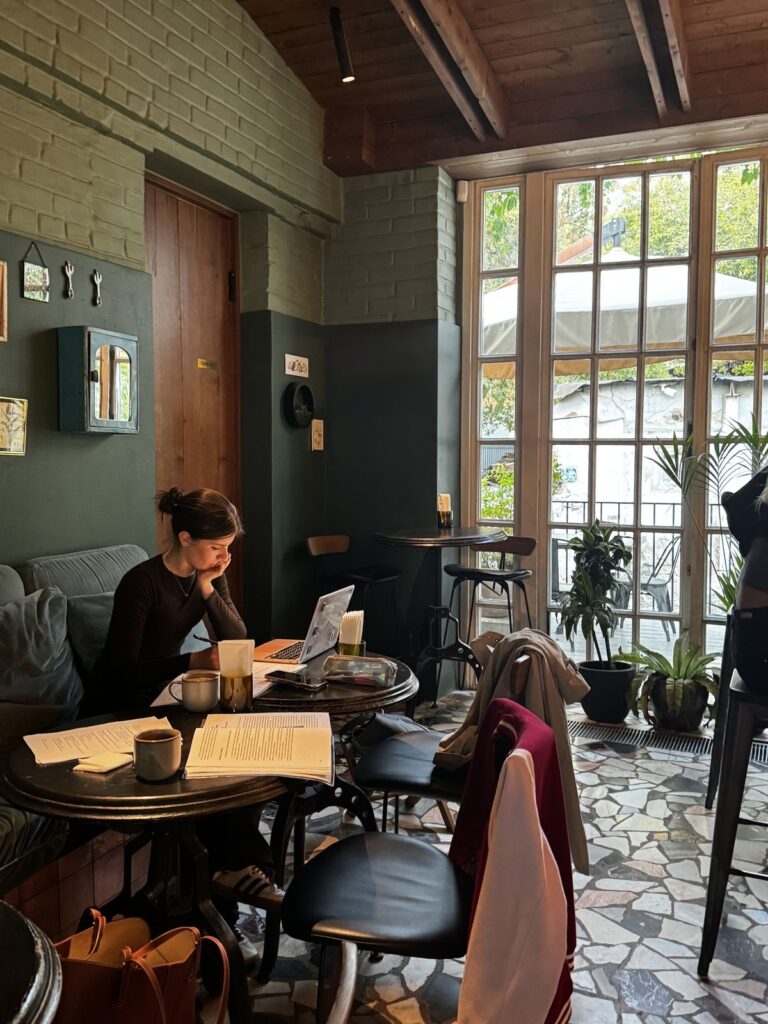
Even the ceiling height changes thinking. Some studies suggest that higher set ceilings influence abstract thinking and creativity, whereas low set ceilings help with detail-oriented thinking and focus. Why is this? High ceilings make a space feel more expanded and psychologists believe that this effects how the human thinks. This comes down to many reasons. However the most obvious one is because expanded spaces has the effect of allowing creative thinking. Like the thoughts can expand more too. Psychologically low ceilings create more pressure which leads to focus and is proven to be better for studying. Therefore students tend to stay for longer periods of time in cafe’s who have lower set ceilings compared to others. But of course the ceiling should not be too low because this could increase stress and can make people feel irritated.
