
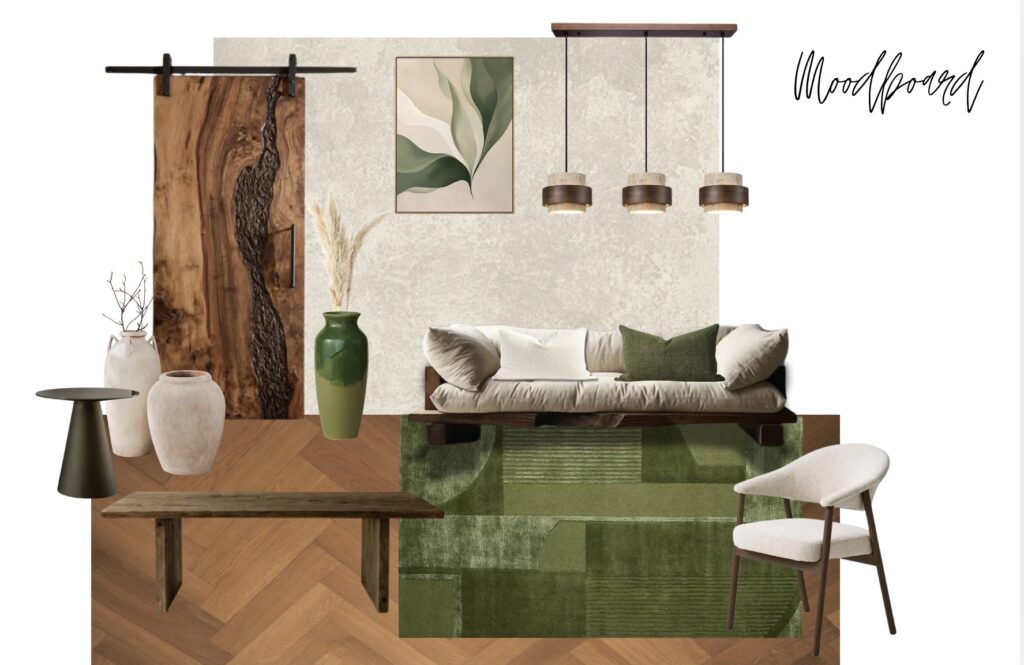
Take a look at my moodboard above. I created this specifically thinking about how our brain and eyes work.
Without thinking, your eyes probably landed somewhere before you started exploring the rest of the composition. Maybe it was the deep green vase. Maybe the striking live-edge wooden door. Or perhaps the rich green rug beneath the sofa.
What’s interesting is that this wasn’t your decision, it was your brain’s.
Our visual system is constantly trying to make sense of the world as efficiently as possible. Instead of examining every object one by one, it immediately searches for contrast: something different from its surroundings. Whether it’s a bold color, an unusual texture, or a distinctive shape, our brains instinctively treat it as important.
This is exactly the principle I explored while creating this moodboard.
The overall palette is intentionally calm. Soft creams, warm oak, beige fabrics, and natural wood create a quiet background that doesn’t compete for attention. Because everything feels visually connected, even a small amount of color suddenly becomes powerful.
Notice how the green appears throughout the composition. It isn’t concentrated in one object—it is repeated in the artwork, the vase, the rug, and the cushion. These repeated accents act like stepping stones for the eye. Instead of stopping at one focal point, your gaze naturally travels from one green element to the next, creating a smooth visual journey around the room.
Texture plays an equally important role.
The live-edge wooden door immediately attracts attention because it interrupts the smoothness surrounding it. While the walls, ceramics, and upholstery have soft, refined finishes, the dramatic grain and bark of the wood introduce complexity. Our brains naturally spend more time looking at textured surfaces because they contain more visual information to process.
Even the flooring quietly contributes to this movement. The herringbone pattern introduces direction, subtly guiding the eye toward the seating area without the viewer consciously noticing. Above, the pendant lights create strong vertical lines that pull the gaze downward, reinforcing the sofa as the heart of the composition.
None of these decisions were accidental.
Interior designers don’t simply arrange beautiful furniture—they choreograph attention. Every contrast in color, every change in texture, and every repeated material influences where someone looks first, second, and third. A successful composition doesn’t force your eyes to move. It gently persuades them.
Perhaps the most fascinating part is that most people will never notice this happening. They’ll simply describe the room as balanced, comfortable, or beautiful.
But behind that first impression is a carefully designed path—one that begins the moment your eyes enter the space.

Great content! Keep up the good work!
thank you for your support!!